Sweden has shown how not to tackle coronavirus, as it fights now to
save face
16 April 2020 • 3:30pm
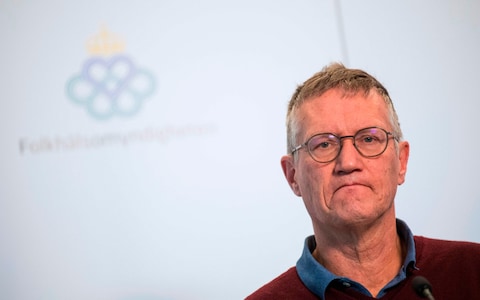 Sweden's chief epidemiologist Anders Tegnell,
from the Public Health Agency of Sweden Credit: JONATHAN NACKSTRAND /AFP
Two weeks ago Swedish state epidemiologist
Anders
Tegnell ruled supreme in Sweden. Almost literally. The Prime Minister,
Stefan Löfven, was rarely seen whereas Mr Tegnell hosted a daily press
conference.
The number of deaths in Sweden, Denmark, Norway and Finland had not yet
started to deviate sharply. Mr Tegnell claimed that the Swedish Health Agency
was on top of the latest and most reliable facts and models. During a period of
hysteria, he was
widely
hailed as a hero for his calm and seemingly scientific focus. Schools,
workplaces and restaurants remained open.
Old people, claimed Tegnell, would be fine if younger Swedes refrained from
visiting their elderly parents in retirement homes. Surely no one responsible
for the health of a nation could be so certain that stricter measures were
unnecessary? Unless also certain that Swedish circumstances really are special?
Not when death curves were rising exponentially in other countries? Mr Tegnell
had to be right, so therefore every critical non-Swedish expert had to be
wrong.
This was a widely held view because, in consensus-oriented Sweden, no other
views were taken seriously, until death rates started creeping up. Finland now
counts 72 dead, Norway 150 and Denmark (the by far most densely populated
Nordic country) 321. Sweden? 1333. Moreover, the Coronavirus has spread
to
a
large number of retirement homes. Why? Because carers have proven to
have little or no protective equipment, thereby making nonsense of the claim
that the low level of intergenerational mixing in Sweden would protect the
elderly.
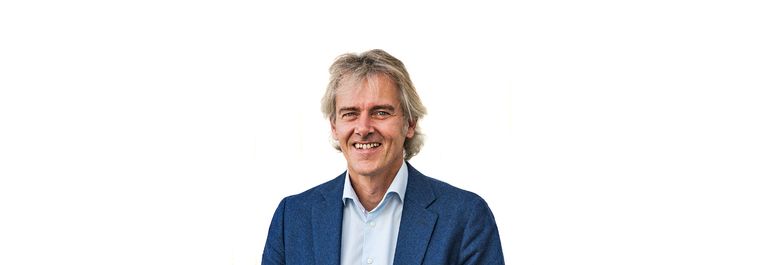
Suddenly, attention turned to the sceptics. One of them is Björn Olsen,
professor of infectious medicine at Uppsala University. Already in 2010 he
published a book,
Pandemic,
in which he foretells much of today’s coronavirus development. He recently
demanded
greater
transparency from the Swedish Health Agency, including access to the
data on which Anders Tegnell rests his case. Mr Olsen received nothing. He has
also publicly criticised the health authorities – and indirectly the government
– for abandoning the elderly. Two days ago, 22 Swedish experts signed a highly
critical
opinion
piece in a leading paper, in which they argue that the Swedish Health
Agency has failed miserably to protect the Swedish people. These experts are
also saying that the government must step in - while waiting for additional
testing kits, protective gear and treatment breakthroughs - and impose stricter
rules.
However, numerous opinion leaders have invested plenty of personal prestige
in Mr Tegnell’s way of tackling the crisis. As a consequence, the critics have
already been attacked with the type of sarcastic ferocity typical for those
deviating from official Swedish positions, including accusations of
shameful
betrayal of the national effort. This time, the issue is extra
sensitive since at stake is nothing less than ownership of the highly charged
concept of solidarity.
The consensus has nevertheless been dented meaning the supremacy of Anders
Tegnell, now increasingly evasive when asked about the development in other
countries, is over. Also, the issue of “more could have been done” has a
special significance in a country in which more
still can be done.
Crowds below 50, for example, are still allowed. Yesterday a much loved
TV-entertainer passed
away from Corona, aged 51. Such a tragedy might have a bigger psychological
impact than 100 new deaths in care homes.
Sweden's chief epidemiologist
defends approach despite high death rate. It is not a failure of policy, it is
a failure of care homes, says Anders Tegnell. @gmfus #coronavirus
pic.twitter.com/RfEnBaxtX0
In most countries – including Denmark, Norway and in Finland - the National
Health Authorities tend to exaggerate risks, to be on the safe side. The
government then decides the trade-offs necessary. In Sweden, the Public Health
Agency has, astonishingly,
played
down the health risks. Almost as astonishingly the government
has, almost to the letter, followed the course recommended by Anders Tegnell.
If looking at the history of the Swedish Social Democratic party, it is hard to
deny its impressive record of statesmen who – in the realist vein of Clement
Attlee – have stepped forward and offered clear and decisive leadership in
times of crisis. Not so this time.
Anders Tegnell’s numerous defenders continue to claim he remains the only
cool guy around. However, there is also the possibility that he, a technocrat
previously unused to the limelight, was initially seduced into a corner.
Seduced by the sudden hero status gained when offering the comforting facts and
interpretations we all wanted to be true.
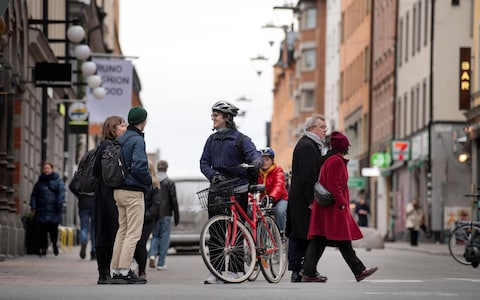
People
talk on a street in the Sodermalm district, as the spread of the coronavirus
disease continues (Covid-19) in Stockholm Credit: TT NEWS AGENCY /REUTERS
It is now possible to conclude, sadly, that the more “relaxed” Swedish
strategy is not likely to transform into a success story. Not only are death
rates a lot higher than in comparable countries. Even the key economic argument
– that the-show-must-go-on - might backfire. How so? Norway and Denmark appear
to have the situation sufficiently in control to cautiously start opening up
their societies. A phased reopening of Danish schools was initiated yesterday
and, starting next week, Norway is planning a similar phasing in.
A
recent
study drawing lessons from the Spanish flu crisis, produced jointly by
the US Federal reserve and MIT, suggests a period of pain and uncertainty might
turn out longer
without the
early lockdown pill:
“Cities that implemented early and extensive non-pharmaceutical
interventions (like physical distancing and forbidding large gatherings)
suffered no adverse economic effects over the medium term. On the contrary,
cities that intervened earlier and more aggressively experienced a relative
increase in real economic activity after the pandemic subsided.”
The Swedish government and the Swedish Health Agency are no
longer fighting for glory. Now they are fighting to get away without fatal
wounds to their reputations. At least domestically, they might be able to pull
it off. Officially, no one has admitted that the original course was imprudent,
but step-by-step action has been taken that has nevertheless led to more
prudence. On the field of practical reality, key workers have, throughout
this crisis, achieved miracles which in a big way have compensated for the lack
of political guidance.
In a society in which most elderly either live alone or are put away in care
homes, it also seems perfectly possible the majority will accept the higher
death toll – unless numbers turn out even more grotesque. If the Swedish
Health Agency’s
interpretation of
the most recent figures is correct, the number of new cases could finally be in
decline. A by now typical message from the Prime Minister also has
some merit: “Yes, more could have been done but now is not the time for
reproach”. Unless, that is, people keep dying who can be saved.